Background
The purpose of this project is to assess local community issues, define a specific grassroots issue, and create a responsive web experience to address our chosen issue for Purdue’s Campus experience.
Project Goal
The goal of our project is to provide a sense of community support and empower Purdue students through relaxed engagement instead of the current costly, inconsistent, and unreliable resources.
My Role & Team
Jerry Anglin - UX Designer
Alex Lederman, Sadie Bunting, Richie Arkanoff, Alex Schrankel, Sophie Regele
Timeframe
September 2021 - October 2021
At a glance…
“Do you feel frustrated? Do you want to burn something? Head over to Angry Boilers to vent about your frustrations, watch your problems go up in flames, and read what your fellow Boilers are annoyed about!”
Our final design is a website that allows Purdue students to: write about their issues and annoyances, choose whether they want their post visible to others or not, read what other students are posting about, and watch their letter go up in flames. We found that students need a place to air their grievances without anonymity worries, so our website utilizes a grassroots approach to provide students an immediate response to their frustrations and relief of stress and negativity.
Our website encourages healthy emotional expression and gives students a safe way to talk about anything that is bothering them. Journaling and destruction are two distinct ways to express emotions, and by combining them, our website caters to a wide range of students and their unique ways of dealing with stress and negativity.
Co-design Workshop
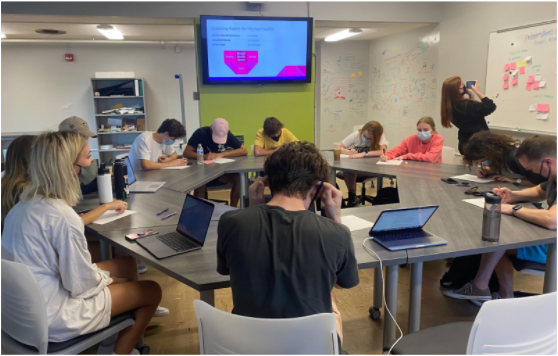
Icebreaker: We learned that it can be beneficial to start a session with a relaxed tone to drive more meaningful conversations and reflections about our topics.
Idea Grouping: We found that participants did not feel confident enough in their knowledge of Purdue’s mental health resources, so we decided that our scope needed to be shifted towards student-to-student interactions, rather than trying to combat the larger issues of accessibility, visibility and awareness.
Creating Space for Mental Health: This helped us understand that there are substantial differences between individuals who are more inclined toward socialization and those who are inclined toward isolation. At the same time, many of these individuals benefit from several experiences along their specific continuums.
Reflection Discussion: This guided us to common topics of concern for mental health at Purdue such as stress from unorganized class preparation and not having knowledge about unstructured and “fun” activities to relieve stress.
Workshop Insights
Resources besides basic therapy sessions need to be made more accessible. Within Purdue’s on-campus community, basic therapy sessions are accessible but limited per student. Within our workshop, we found that there are many other resources available that go beyond basic therapy sessions.
Instead of damage control, proactive services should be provided. CAPS usually has intake issues because they are not equipped for the number of students needing assistance. This causes CAPS to simply check if the student is a threat to themselves or others, which is a reactive reaction to mental health, rather than proactively trying to help students from reaching a physically harmful state.
There is a lack of awareness surrounding CAPS and CAPS resources. Throughout the duration of our workshop, our participants were disappointed in the quality of care or unaware of the resources offered by CAPS. Our participants did not know the location of CAPS, the cost of its services, or even the resources CAPS provides, pointing us towards a solution separate from CAPS.
Final Designs
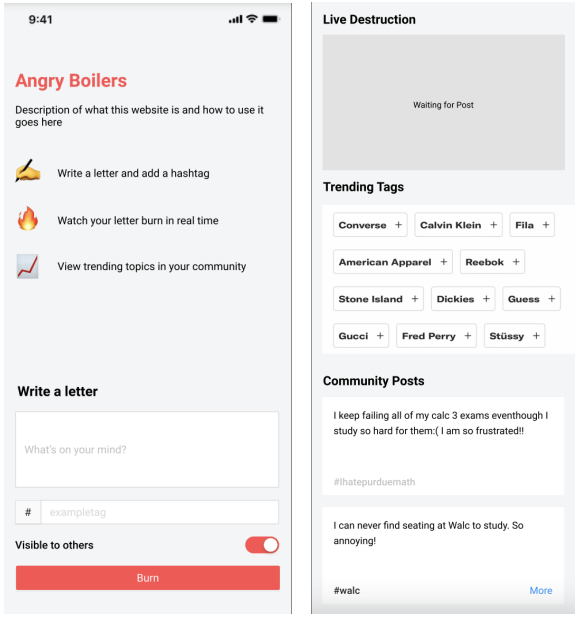
Mobile
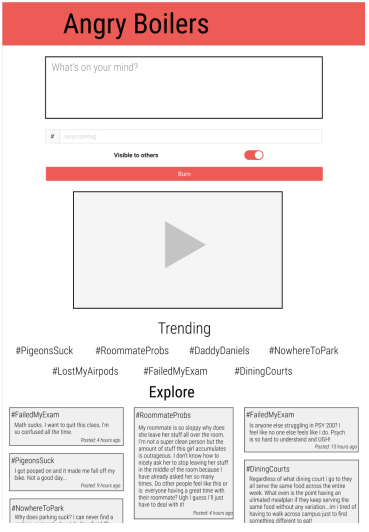
Tablet
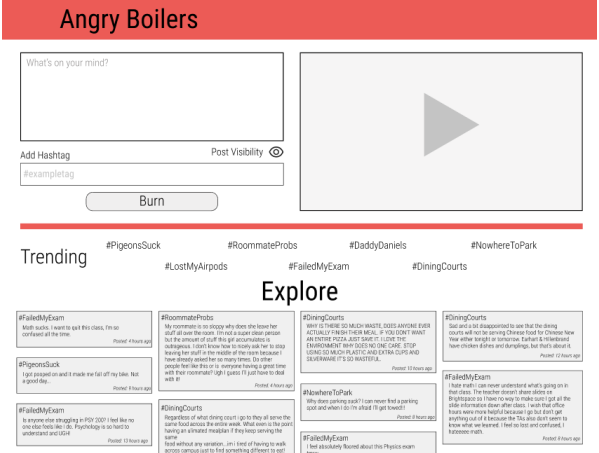
Desktop